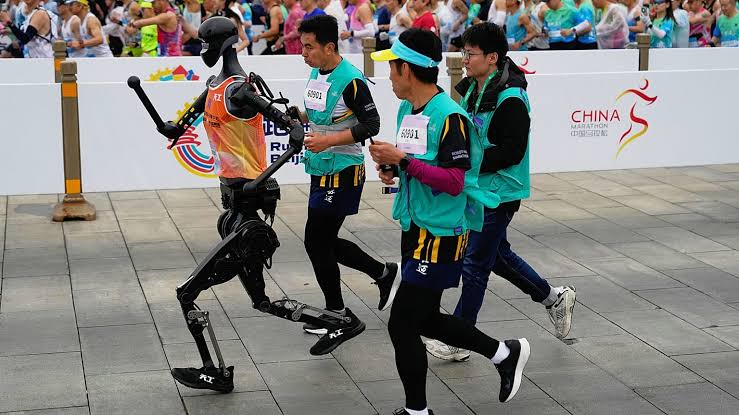

A Chinese humanoid robot is raising the bar for robotic speed after completing a half-marathon in Beijing faster than the world’s fastest human runners, demonstrating the rapid progress being made in artificial intelligence, robotics and machine-powered mobility.
The humanoid, known as “Flash”, is a high-performance robot developed by Chinese smart-device maker Honor. The company is now putting the machine through intensive training as it prepares for the Second World Humanoid Robot Games, scheduled to take place in Beijing from August 22 to 26.
Flash’s performance in a half-marathon earlier this year has attracted attention because of the robot’s ability to maintain a running pace that would be beyond the limits of human athletes. The achievement highlights how advances in robotics are increasingly moving machines from controlled laboratory environments into demanding real-world physical activities.
The robot’s development comes as China positions itself at the forefront of the global humanoid robotics industry, with companies and research institutions investing heavily in machines capable of walking, running, lifting objects and interacting with humans.
The upcoming World Humanoid Robot Games will provide another major test of those capabilities. More than 2,000 robots from 666 teams representing 16 countries and regions are expected to participate, according to organisers.
The number of participating robots has quadrupled compared with last year’s inaugural edition, reflecting the rapid expansion of interest in humanoid robotics and artificial intelligence.
The event will feature more than 30 competitions, giving participating robots opportunities to demonstrate their abilities across a range of physical and technical challenges.
These will include obstacle courses, endurance races, long jump, weightlifting, tug of war, and table tennis, among other competitions.
For Flash, however, running remains one of its biggest strengths.
Unlike conventional industrial robots, which are generally designed to perform repetitive tasks in controlled environments, humanoid robots are being developed to move through environments designed for people. This requires sophisticated coordination between artificial intelligence, sensors, motors, batteries, and mechanical systems.
Running is particularly difficult because it requires continuous control of balance and movement. A human runner instinctively adjusts posture, stride length and foot placement while responding to changes in terrain. A humanoid robot must achieve similar stability through sensors, algorithms, and mechanical systems.
Flash’s half-marathon performance therefore represents more than a demonstration of raw speed. It also shows the growing ability of humanoid robots to coordinate multiple systems while performing physically demanding tasks for extended periods.
The development could eventually have applications beyond sporting competitions. Faster and more capable humanoid robots could be deployed in environments where speed, endurance, or physical strength are important, including logistics, manufacturing, emergency response, construction, and other industrial applications.
The robot games are also becoming an important platform for companies to compare competing technologies. By placing robots in the same environment and testing them against similar challenges, the event allows developers to identify weaknesses and improve future generations of machines.
The growth in participation is particularly significant. Last year’s inaugural competition attracted a much smaller field, while this year’s event will bring together thousands of robots and teams from around the world.
The expansion indicates that humanoid robotics is moving rapidly from an emerging technology into a competitive global industry.
China has emerged as one of the leading markets for humanoid robot development, supported by its large manufacturing base, artificial intelligence capabilities, and growing investment in advanced technologies.
For Honor, the development of Flash also represents an expansion beyond the company’s traditional smart-device business. By investing in robotics, the company is entering a sector expected to play an increasingly important role in the future of automation.
The race to build faster, smarter and more capable humanoids is likely to intensify as companies compete not only on speed but also on intelligence, battery life, reliability, balance and the ability to perform useful tasks.
Flash’s half-marathon achievement offers a glimpse of what that competition could produce.
While human athletes remain unmatched in adaptability and the ability to perform across unpredictable environments, machines such as Flash are demonstrating a different advantage: the potential to combine speed, endurance and computational precision without experiencing the physical fatigue that limits human performance.
As the World Humanoid Robot Games open in Beijing, the focus will therefore extend beyond who wins individual events. The competition will provide a glimpse into how quickly robotics is advancing and how machines could increasingly become capable of performing tasks once considered exclusively human.
With more than 2,000 robots expected to compete, the message from Beijing is becoming increasingly clear: the humanoid robot race is no longer a futuristic concept.
And with Flash already proving its speed on the road, the next generation of robots may be ready to run—and perhaps work—faster than ever before.